2005
+
million
people are affected by PAD globally.
Criqui MH, et al. (2015) / Fowkes FG et al. (2013)


Iliac artery disease is increasing worldwide and can have a severe clinical impact. Iliac artery stenoses are frequently calcified. Procedures involving the iliac arteries can pose risks such as stent migration, dissection and rupture. Lesions in the iliac, specifically TASC D lesions, may be present as focal, multi-segment or bilateral lesions.
Why Iliac Disease matters2005
+
million
people are affected by PAD globally.
Criqui MH, et al. (2015) / Fowkes FG et al. (2013)
1/31
Of PAD patients have iliac lesions
PAD4
is underdiagnosed and undertreated.
Olinic DM et al. (2018)
50%1
of symptomatic PAD cases are caused by Iliac artery disease
Increasing2
number of severe (Tasc C & D) iliac lesions treated endovascularly
>40%3
of iliac PTA cases are associated with a hemodynamically significant residual stenosis.
1. Rossi, Michele, and Roberto Iezzi. "Cardiovascular and Interventional Radiological Society of Europe guidelines on endovascular treatment in aortoiliac arterial disease." Cardiovascular and interventional radiology 37.1 (2014): 13-25.
2. Leville, Christopher D., et al. "Endovascular management of iliac artery occlusions: extending treatment to TransAtlantic Inter-Society Consensus class C and D patients." Journal of vascular surgery 43.1 (2006): 32-39.
3. Ruggiero II, Nicholas J., and Michael R. Jaff. "The current management of aortic, common iliac, and external iliac artery disease: basic data underlying clinical decision making." Annals of vascular surgery 25.7 (2011): 990-1003.
4. Olinic, Dan-Mircea, et al. "Epidemiology of peripheral artery disease in Europe: VAS Educational Paper." International angiology: a journal of the International Union of Angiology 37.4 (2018): 327-334.
5. Criqui, Michael H., et al. "Lower extremity peripheral artery disease: contemporary epidemiology, management gaps, and future directions: a scientific statement from the American Heart Association." Circulation 144.9 (2021): e171-e191.
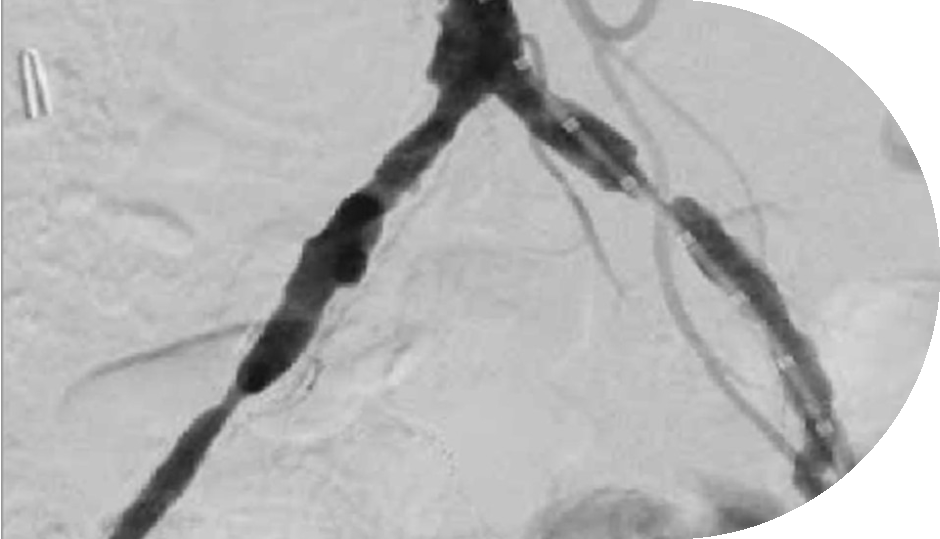
Image Source: Bolster Clinical Study
Restoring arterial patency is a critical step in stabilizing the limb and enabling effective subsequent management.
Endovascular treatment of iliac obstructive disease is now a safe and durable approach, and is often the first line therapy. Complex long-segment and bilateral iliac occlusions can be safely treated via endovascular means with high rates of symptom resolution.

Bare metal stents showed significantly lower freedom from target lesion revascularization, compared to covered stents during a 24-month follow up.

Severe calcification, identified as the only independent predictor of primary patency, has been shown to challenge BMS durability, where CS demonstrate notable advantages.

Studies of TASC D lesions report lower mid-term patency with bare metal stents than covered stents for longer lesions lesions (> 6cm) and longer occlusions (>3,5 cm)
1.Zeng, Chenlin, et al. "Covered stents vs bare metal stents for aortoiliac arterial diseases: a systematic review and meta-analysis." Journal of Endovascular Therapy 32.5 (2025): 1317-1325.
2. Li, Jialiang et al., Outcomes of covered vs bare metal stents for the treatment of aortoiliac occlusive disease Journal of Vascular Surgery, Volume 79, Issue 2, 330 – 338
3. Piazza, M. et al., Editor's Choice – Outcomes of Self Expanding PTFE Covered Stent Versus Bare Metal Stent for Chronic Iliac Artery Occlusion in Matched Cohorts Using Propensity Score Modelling, European Journal of Vascular and Endovascular Surgery, Volume 54, Issue 2, 177 – 185


As a growing proportion of long, calcified, and complex iliac lesions are now being treated endovascularly, treatment selection may need to adapt to the demands of these more advanced anatomies. Across published studies, self-expanding Covered Stents (CS) have demonstrated improved patency results compared to BMS in:
Covered stents increased freedom from target lesion revascularization compared to BMS during a 24-month follow up.
Better primary patency in long lesions (> 6 cm) and long occlusions (>3.5 cm), referring to TASC D lesions2.
Improved primary patency in TASC D occlusions with > 75% circumferential calcification2.
1.Zeng, Chenlin, et al. "Covered stents vs bare metal stents for aortoiliac arterial diseases: a systematic review and meta-analysis." Journal of Endovascular Therapy 32.5 (2025): 1317-1325.
2. Li, Jialiang et al., Outcomes of covered vs bare metal stents for the treatment of aortoiliac occlusive disease Journal of Vascular Surgery, Volume 79, Issue 2, 330 – 338
3. Piazza, M. et al., Editor's Choice – Outcomes of Self Expanding PTFE Covered Stent Versus Bare Metal Stent for Chronic Iliac Artery Occlusion in Matched Cohorts Using Propensity Score Modelling, European Journal of Vascular and Endovascular Surgery, Volume 54, Issue 2, 177 – 185
Successful vessel reopening has been shown to translate into measurable improvements in patient quality of life, as assessed by the WIQ in the Bolster study.
Contact us
BD is committed to keeping your personal data protected and secure. More information on how we protect your personal data can be found in our privacy notice and our cookie policy